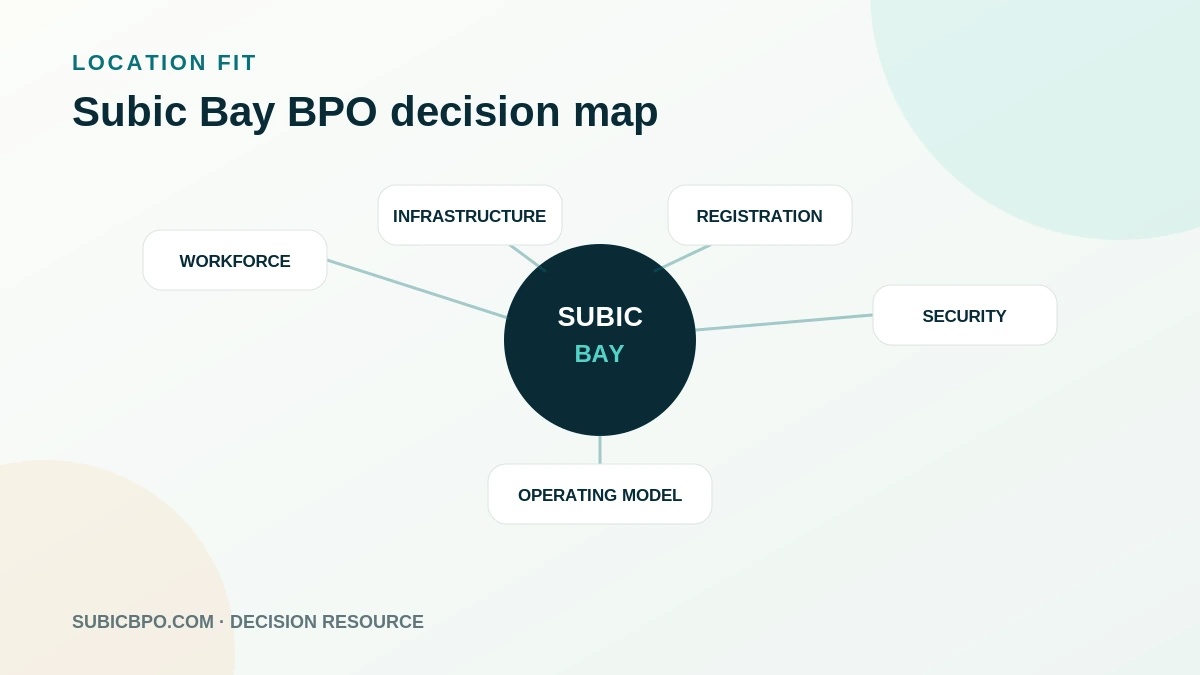
TL;DR
Subic Bay is a legitimate Philippine location for BPO, IT-BPM, shared-services and other offshore operations. The Subic Bay Metropolitan Authority lists call centers, BPO, software development and IT-BPM among its investment opportunities, and the IT & Business Process Association of the Philippines identifies Subic Bay Freeport Zone as a BPO location.
That establishes relevance, not automatic suitability. The decision still depends on the exact work being moved, the available talent pool, the building and telecom design, the registration path, customer-security requirements, operating costs and the amount of control the company wants to own directly.
The right question is therefore not “Is Subic good for BPO?” It is “Does Subic fit this operation better than the realistic alternatives?”
Why Subic belongs on the shortlist
The Freeport already has an institutional structure for ICT investment. SBMA maintains a Business and Investment Department focused on Information and Communications Technology, and its current investment-opportunities page explicitly includes BPO and IT-BPM activities.
IBPAP separately describes the Philippines as a major global IT-BPM delivery market and lists Subic Bay Freeport Zone alongside Metro Manila and Clark as a Philippine location for BPO investment. IBPAP's current public material describes a national industry with roughly 1.9 million workers and about US$40 billion in revenue, which is useful context: a Subic project operates inside a mature national outsourcing ecosystem rather than an isolated local niche.
Subic can be particularly interesting when an operation values some combination of:
- a Freeport business environment;
- access to Central Luzon rather than a Metro Manila-only labor strategy;
- proximity to logistics, port and aviation infrastructure;
- a lower-density operating location than the largest Philippine business districts;
- the ability to combine BPO, technology, ecommerce, back-office, logistics or regional support functions in one broader operating plan.
None of those factors should be converted into a generic promise of lower cost or faster setup without project evidence.
Define the operation before comparing locations
A location comparison is only useful after the operating model is specific enough to test.
A 25-person ecommerce support unit, a 250-seat voice center, a finance shared-services team and a software engineering office may all be called “BPO” in casual conversation, but they create very different requirements.
Before scoring Subic against Clark, Metro Manila, Cebu or another location, define at least:
- the services being delivered;
- customer geography and working hours;
- launch headcount and 24-month headcount;
- voice, non-voice and technical work mix;
- language and specialist-skill requirements;
- onsite, hybrid or remote constraints;
- data types and customer-security obligations;
- required uptime and recovery objectives;
- target launch date;
- expected expansion pattern;
- whether the company wants to build, outsource or acquire the operating platform.
Without that definition, a location study usually degenerates into generic claims about labor cost, English proficiency, incentives and connectivity.
Workforce: test the exact hiring problem
SBMA's Labor Department says one of its functions is helping investors source employment requirements. Its public materials also describe recruitment-assistance processes and coordination with nearby cities and municipalities.
That support is useful, but it is not a substitute for a recruiting test.
For a material launch, run a pilot using representative roles before making an irreversible facility commitment. Measure:
- number of qualified applicants;
- interview pass rate;
- salary expectations;
- notice periods;
- commute origin and travel constraints;
- night-shift acceptance;
- offer acceptance rate;
- early attrition indicators;
- availability of supervisors, QA, trainers, workforce management and IT support.
Entry-level candidate volume can look healthy while team-lead, technical or specialist roles remain difficult. A serious workforce model separates those roles instead of treating “agents” as one interchangeable category.
See the workforce and recruitment guide for the operational checks behind the headline headcount.
Infrastructure: evaluate the building, not the city
Subic's overall infrastructure can be attractive, but a BPO operates from a particular building and network design.
A location may have several telecom providers while a candidate building has only one practical last-mile path. A generator may exist while its capacity, maintenance or fuel arrangement does not support the expected load. A landlord may permit 24-hour access while HVAC is not designed for full night-shift operation.
For every serious property, verify:
- carrier availability at the exact address;
- physical route diversity, not merely two provider names;
- building entry points for telecom circuits;
- generator capacity and transfer behavior;
- UPS coverage and runtime;
- cooling availability for operating hours and equipment rooms;
- fire and life-safety status;
- physical-access controls;
- parking and employee transport realities;
- expansion space and fit-out constraints.
Where continuity matters, test failover instead of accepting a diagram or sales statement.
The infrastructure and connectivity guide goes deeper into those checks.
Registration and incentives: treat them as a workstream
SBMA publishes a business-registration process and maintains an ICT investment function. At national level, the incentives framework now sits under the CREATE/CREATE MORE system and the current Strategic Investment Priority Plan.
FIRB announced the approval of the 2026 SIPP in June 2026. That is an important reminder that incentive eligibility is versioned policy, not an evergreen benefit attached to the phrase “Freeport company.”
Before placing an incentive assumption into a board paper or financial model, confirm:
- the entity being registered;
- the exact project or activity;
- the responsible Investment Promotion Agency;
- current SIPP treatment;
- export-versus-domestic classification where relevant;
- the applicable incentive regime and period;
- performance and reporting commitments;
- effects of ownership, activity or location changes.
See the SBMA registration guide for the current planning sequence.
Cybersecurity and privacy belong in the location decision
For many offshore operations, technology and data obligations are not secondary IT details. They determine what facility, network, systems and operating procedures are acceptable.
The Philippine Data Privacy Act and its implementing rules explicitly address outsourced processing of personal data. The National Privacy Commission states that controllers remain accountable for personal data that is outsourced or transferred, and outsourcing arrangements should define processing responsibilities and safeguards.
A buyer should therefore establish early:
- what personal or sensitive data will be processed;
- where systems and backups reside;
- which party controls access;
- whether subcontractors are involved;
- customer contractual controls;
- MFA, endpoint and privileged-access requirements;
- logging and monitoring expectations;
- incident notification and response requirements;
- recovery-time and recovery-point objectives.
These requirements can change the viable provider, property and cost model. See Cybersecurity and Business Continuity.
Build, outsource or acquire changes the Subic question
The same location can make sense under one operating model and not another.
Build when long-term control over people, systems, governance and customer delivery justifies setup time and capital.
Outsource when the function can be governed effectively through a provider and speed or flexibility matters more than owning the platform.
Acquire when a specific existing company or operating base solves real setup problems and the inherited liabilities are acceptable after due diligence.
The Build vs Outsource vs Acquire guide provides a common scorecard for those options.
Use a written decision record
For each important assumption, write down the evidence, source, date, owner and what would invalidate it.
| Assumption | Evidence to obtain |
|---|---|
| We can hire 80 people in 90 days | Recruiting pilot, salary evidence and hiring funnel |
| Two carriers are available | Written site surveys and physical path review |
| The project qualifies for incentives | Current IPA/FIRB and professional confirmation |
| The facility can run 24/7 | Lease, HVAC, access, power and security evidence |
| Customer data can be processed there | Contract, privacy and security-control review |
| Acquisition saves meaningful time | Transaction-specific transfer and transition plan |
That approach turns “Why Subic?” from a marketing question into an operating decision that can be defended later.
Primary sources and further reading
- SBMA Investment Opportunities
Official SBMA list including call centers, BPO, software development and IT-BPM. - IBPAP Investors
Industry material identifying Subic Bay Freeport Zone as a Philippine BPO location. - SBMA ICT Business and Investment Department
Official ICT investment function inside SBMA. - SBMA Labor Department
Official labor and manpower-support functions for Freeport investors and locators.