TL;DR
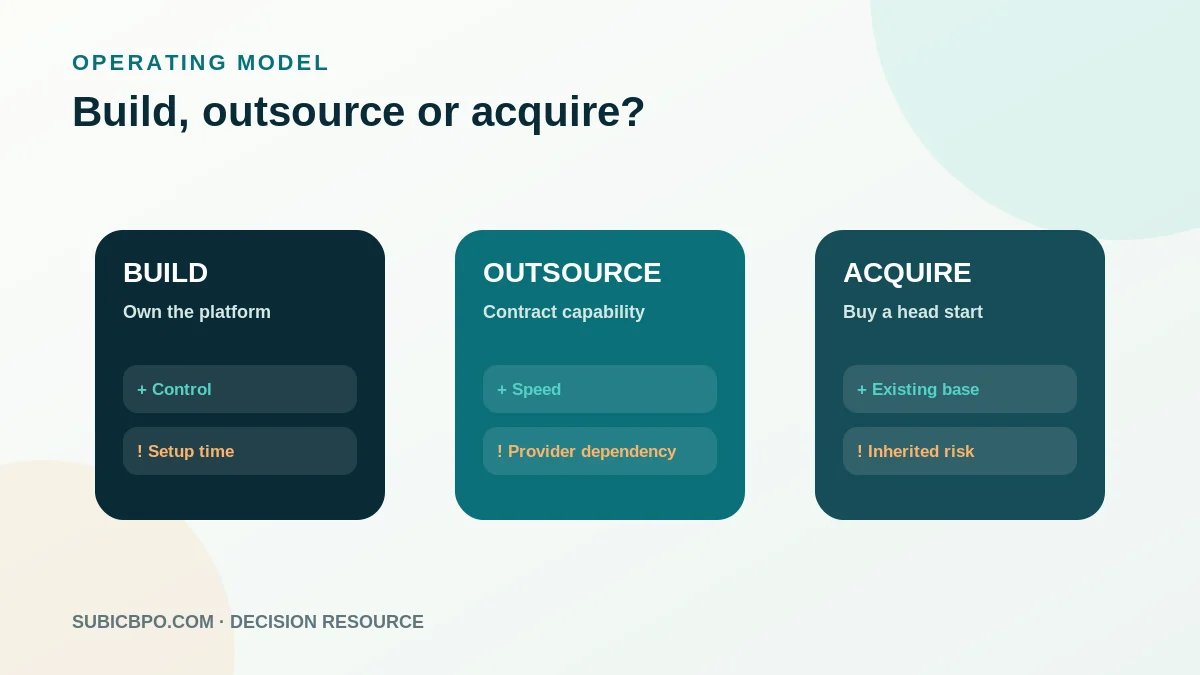
There are three fundamentally different ways to establish offshore capability in the Philippines:
- Build the operating platform yourself.
- Outsource the capability to an existing provider.
- Acquire an existing company, assets or operating platform.
The fastest path is not always the lowest-risk path, and the highest-control path is not always the best use of management time or capital.
Use Build when long-term control justifies the setup effort. Use Outsource when the function can be governed effectively through a provider. Investigate Acquire when a specific operating platform can shorten the launch without importing unacceptable liabilities.
Build: own the operating system
A greenfield build gives the buyer the greatest control over:
- corporate structure;
- leadership and culture;
- office location and fit-out;
- hiring standards;
- technology stack;
- security architecture;
- customer processes;
- quality and workforce management;
- continuity design;
- vendor selection.
That control is valuable when the offshore operation is strategic and expected to remain important for years.
The tradeoff is project complexity. The company must create the legal, physical, technical and people platform before customer work can begin.
A greenfield build also creates visible risk: everybody can see that recruiting, fit-out, registration, carrier provisioning and commissioning still need to happen. That visibility is useful because it makes the project plan honest.
Build is usually strongest when
- the work is core or strategically sensitive;
- customer/security requirements demand direct control;
- headcount can justify dedicated management and infrastructure;
- the company expects long-term scale;
- the launch timetable allows proper setup;
- the company has local or experienced project leadership.
Build is weaker when
- the scope is small or uncertain;
- time-to-launch is extremely short;
- management does not want to own local operations;
- recruiting or regulatory assumptions remain untested;
- the company values exit flexibility more than platform ownership.
Outsource: turn infrastructure into a governed contract
With outsourcing, the provider already owns much of the operating machinery: entity, people, supervisors, office, systems and local administration.
That can reduce setup friction dramatically.
But outsourcing does not eliminate governance. It changes the questions.
The customer should understand:
- which legal entity signs the contract;
- who employs the staff;
- whether subcontractors are used;
- where the team physically works;
- how quality is measured;
- what service levels actually mean;
- how privileged/customer access is controlled;
- where customer data flows and is stored;
- what continuity exists;
- how incidents are reported;
- how transition or termination works.
The Philippine Data Privacy Act framework is particularly relevant when a provider processes personal data for a customer. The National Privacy Commission's implementing rules say outsourced processing should be governed by a contract or legal act that defines the processing and appropriate safeguards.
A polished provider can make operational risk less visible than greenfield risk. That is why demonstrations, office tours and sales decks should be followed by evidence: staffing records, control documents, customer references where permitted, security findings, continuity tests and contractual commitments.
Outsource is usually strongest when
- the function is clearly defined;
- speed matters;
- volume is variable or uncertain;
- the provider already has the required capability;
- direct local management is not strategically necessary;
- the contract can create enough control and transparency.
Outsource is weaker when
- the work requires unusually deep company integration;
- data/security requirements are incompatible with the provider's model;
- the provider has weak transparency;
- long-term provider margin materially exceeds the value of flexibility;
- transition risk makes switching difficult.
Acquire: buy a head start, not a promise
An acquisition can provide a shortcut to capabilities that would otherwise take time to create.
Depending on the transaction, that may include:
- an existing corporation;
- Freeport operating history or registrations;
- lease rights or premises;
- equipment;
- employees;
- customer contracts;
- vendor relationships;
- bank relationships;
- domains and digital assets;
- software, documentation or internal processes.
The critical distinction is between “exists before closing” and “survives closing in usable form.”
A lease may require consent. A bank may need fresh KYC and signatory approval. A customer contract may restrict assignment or change of control. Employees can resign. Software licenses may not transfer. An incentive may relate to a specific registered activity rather than the corporation in the abstract.
That is why acquisition value is a due-diligence conclusion rather than a brochure claim.
Evaluate a specific Subic acquisition path
BPOForSale.com presents an existing Philippine corporation and Subic Bay operating-base opportunity. Review it as a transaction with its own documents, transfer requirements and risks—not as evidence that acquisition is always the best path.
Compare all three paths on the same scorecard
Each option tends to be sold on its strongest dimension. Build is sold on control. Outsource is sold on speed. Acquisition is sold on the head start.
Force all three to answer the same criteria.
| Criterion | Build | Outsource | Acquire |
|---|---|---|---|
| Time to initial service | Usually longest | Often shortest | Can be short if transfers are clean |
| Upfront capital | Higher | Lower/moderate | Purchase price + remediation |
| Direct operational control | Highest | Contractual | High after control transfers |
| Recruiting burden | Buyer owns it | Provider owns much of it | Depends on retained workforce |
| Facility commitment | Buyer | Provider | Often inherited/renegotiated |
| Technology control | Highest | Shared/limited | Depends on inherited stack |
| Hidden liabilities | Low inherited liability | Provider dependency | Highest diligence requirement |
| Exit flexibility | Lower after build | Usually higher | Depends on assets/contracts |
| Management bandwidth | High during launch | Lower | High during diligence/transition |
The table should be customized with weights that reflect the actual project rather than treated as a universal ranking.
Compare total economics, not the first invoice
A fair comparison uses the same time horizon and service assumptions.
For Build, include:
- setup and professional fees;
- rent and deposits;
- fit-out;
- recruitment and training;
- management overhead;
- technology and security;
- redundancy and continuity;
- startup under-utilization.
For Outsource, include:
- provider margin;
- onboarding/transition;
- management and vendor-governance cost;
- change requests and minimum commitments;
- exit/transition cost.
For Acquire, include:
- purchase price;
- advisers and due diligence;
- taxes/transaction costs where applicable;
- working capital;
- technology remediation;
- facility upgrades;
- employee retention;
- customer/vendor consents;
- post-closing integration.
A low acquisition price can still be expensive if systems must be replaced. A high outsource unit rate can still be attractive if the alternative is a lightly utilized dedicated platform.
Hybrid strategies are often rational
Real operating models do not always fit a clean three-box framework.
Examples:
- outsource for six months while building a captive team;
- acquire the corporation and location but replace the technology stack;
- build a core operation and outsource overflow;
- outsource commodity work while keeping sensitive functions captive;
- acquire an operating base and recruit a new team into it.
The useful question is not “Which label are we?” It is which capabilities do we need to own, which can we contract, and which are worth buying already assembled?
Use decision gates before committing
A disciplined process can use three gates:
Gate 1 — strategic fit: Does Philippine delivery solve a real business problem?
Gate 2 — operating model: Which capabilities need ownership versus contractual control?
Gate 3 — specific execution: Which site, provider or acquisition target survives the evidence test?
This prevents a company from becoming committed to a provider, lease or transaction before the underlying operating-model decision has actually been made.
Primary sources and further reading
- IBPAP Investors
Philippine IT-BPM investor information and location context. - SBMA Investment Opportunities
Official Subic Bay investment categories including BPO and IT-BPM. - National Privacy Commission - Outsourcing rules
Official rules relevant to outsourced processing of personal data.