TL;DR
SBMA has a published business-registration process, a dedicated ICT investment function and an investment-opportunities list that explicitly includes call centers, BPO, software development and IT-BPM.
That does not mean every BPO project receives the same registration or tax outcome. The national incentives framework now operates under CREATE/CREATE MORE and the current Strategic Investment Priority Plan, so the project, entity, activity and current rules must be reconciled before incentives are placed into a financial model.
Use the public material to prepare. Use the responsible SBMA/FIRB process and professional advice to confirm the actual treatment.
Start with the current SBMA registration page
SBMA's Business Registration page describes a staged process for prospective investors.
Its Stage I list includes items such as:
- SBF Investment Application Form;
- Letter of Intent;
- Business Plan;
- authorization of the official representative;
- corporate or business-registration documents;
- personal information documents for incorporators;
- supporting documents for sublease or development arrangements where applicable;
- permits and licenses required by law.
The business-plan elements shown publicly include a company profile, scope of operation, projected financial statements and a risk and safety assessment.
That is useful because it reveals the correct preparation mindset: registration is not merely an administrative form. The applicant should be able to explain what the operation will do, how it will operate, where it will be located and how it is financially and operationally structured.
Engage the ICT investment function early
SBMA maintains a Business and Investment Department for Information and Communications Technology. Its public description says the department focuses on ICT-sector investment opportunities and provides registration-related links.
For a BPO, shared-services, ecommerce-support, software or other digital-services project, early contact with the responsible investment office can help resolve questions before documents are prepared around the wrong assumptions.
Useful early questions include:
- Does the proposed activity fit the intended registration category?
- Which entity should submit the application?
- Which current forms and documentary requirements apply?
- Does the property arrangement create additional requirements?
- Which other SBMA departments need to review the project?
- Which permits are required before operations begin?
- Which incentive path, if any, should be evaluated separately?
Keep written responses and note the date because procedures and forms can change.
Separate registration from incentives
One of the easiest mistakes is to treat “registering in Subic” and “qualifying for a specific tax incentive” as the same decision.
They are related, but they are not interchangeable.
The national framework changed materially under the CREATE Act and then CREATE MORE (R.A. 12066). FIRB's current CREATE MORE resource page provides the law, implementing rules signed in February 2025 and related explanatory materials.
FIRB also announced Presidential approval of the 2026 Strategic Investment Priority Plan in June 2026. The SIPP identifies priority activities for incentives and evolves over time.
The practical consequence is simple: old economic-zone articles, archived PDFs and legacy marketing summaries should not be used as the final authority for a 2026 investment decision.
Questions to resolve before modeling an incentive
A board or investor model should not contain a tax-incentive benefit until the project team can answer questions such as:
- What exact project or activity is being registered? A broad company description may include activities with different treatment.
- Which legal entity is applying? Ownership and project structure matter.
- Which Investment Promotion Agency is responsible? The filing and approval route must be clear.
- How does the activity fit the current SIPP? Do not infer eligibility from the word “BPO” alone.
- Is the activity export-oriented, domestic-market oriented or mixed? Classification can affect treatment.
- What incentive regime and period would apply? Record the actual basis, not a generic summary.
- What performance commitments apply? Employment, investment, export or other commitments may matter.
- What reporting obligations continue after registration? Incentives are not a one-time application event.
- What happens if ownership, activity, location or scale changes? A transaction or business-model change may require review.
- Which local-tax, VAT, customs or importation rules apply? Current implementation should be checked independently.
For a material investment, obtain written confirmation from the responsible authority and advisers before treating the benefit as bankable.
FIRMS is part of the current incentives workflow
FIRB describes the Fiscal Incentives Registration and Monitoring System (FIRMS) as the online portal used to submit and monitor incentives applications through Investment Promotion Agencies.
FIRB's public guidance tells new applicants to contact an IPA before creating the account. That suggests a sensible sequence:
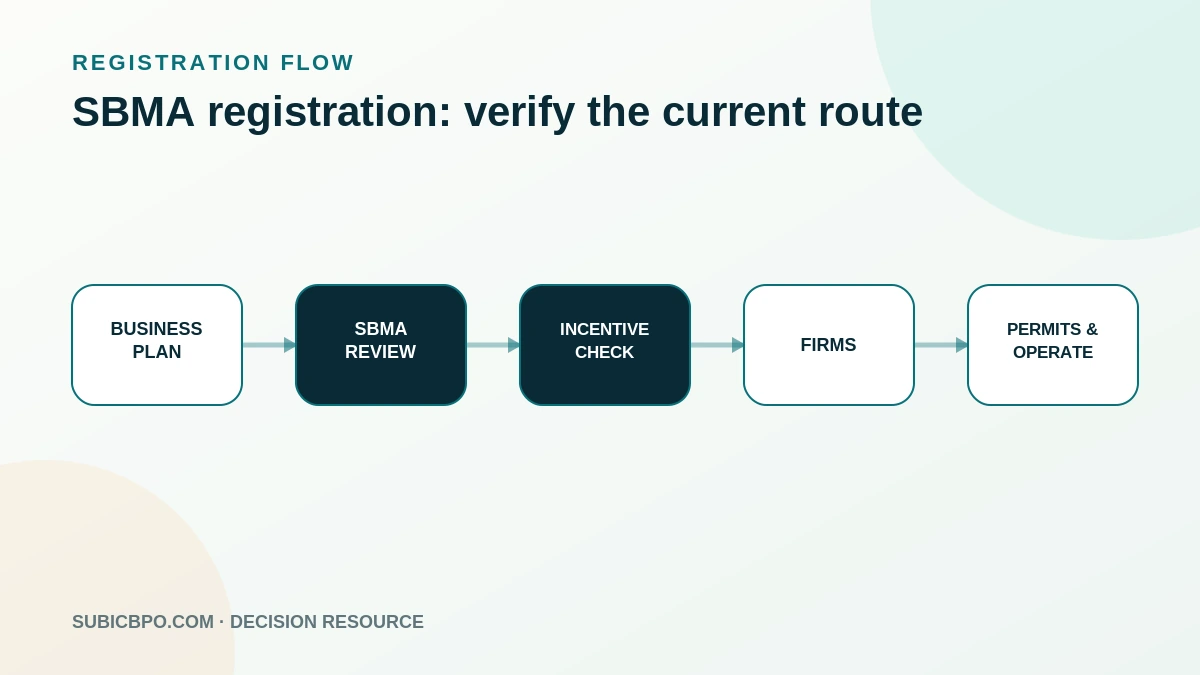
Define the project → speak with the responsible IPA → confirm the current route → prepare documents → use the required filing system.
Creating an online account first does not substitute for understanding what is being registered.
Property and operating permits can create a second critical path
Corporate/investment approval is only part of launch readiness.
SBMA's public registration material also refers to lease/sublease documentation and permits needed for a Business Permit to Operate. Depending on the project, building, occupancy, sanitary, environmental, fire/life-safety and other clearances may affect the launch sequence.
That means the project schedule should show at least two parallel tracks:
- entity/registration/incentives, and
- property/fit-out/operating permits.
A team can have a nearly complete corporate filing while the facility is still unable to operate, or a finished office while the regulatory path remains unresolved.
Employment and foreign-national issues should be planned separately
SBMA's Labor Department supports locators with manpower and labor-related processes and publishes information concerning work permits and foreign-national employment.
If the launch requires expatriate executives, technical specialists or other foreign personnel, add immigration/work-permit timing to the project plan. Do not assume that corporate registration automatically grants the right for a foreign employee to work locally.
For the broader workforce plan, see Workforce and Recruitment.
Build a registration evidence folder
A practical project folder should contain:
- latest application forms;
- written guidance from the responsible office;
- entity documents;
- final business plan used for registration;
- property/lease documents;
- permit matrix;
- incentive analysis and supporting authority;
- filing receipts and application references;
- certificates and approvals;
- performance commitments;
- reporting calendar;
- renewal or expiry dates;
- named internal owner for each obligation.
That folder later becomes valuable in financing, audit, compliance review and acquisition due diligence.
If acquiring an existing company, re-verify everything
An existing corporation may already have registrations, historical approvals or a Freeport operating record. That can be useful—but it should not be valued as if every status automatically survives a sale or change of activity.
Check the current certificates, registered activities, compliance status, pending obligations and the effect of the proposed ownership/business-model change.
For buyers considering this route, BPOForSale.com presents a specific Subic Bay company-acquisition opportunity. It should be reviewed using the same project-specific registration and due-diligence standards described here.
Do not publish one universal incentive promise
There is no responsible single sentence such as “a Subic BPO gets X% tax for Y years” that can substitute for current project analysis.
The safer decision rule is:
Use current public sources to understand the framework, obtain project-specific confirmation, and only then place the incentive into the model.
Primary sources and further reading
- SBMA Business Registration
Current public registration process and requirements. - SBMA ICT Business and Investment Department
Official SBMA ICT investment office. - FIRB CREATE MORE
CREATE MORE law, IRR and current explanatory material. - FIRB FIRMS
Fiscal Incentives Registration and Monitoring System guidance. - FIRB 2026 SIPP announcement
Current confirmation that the 2026 Strategic Investment Priority Plan was approved.