TL;DR
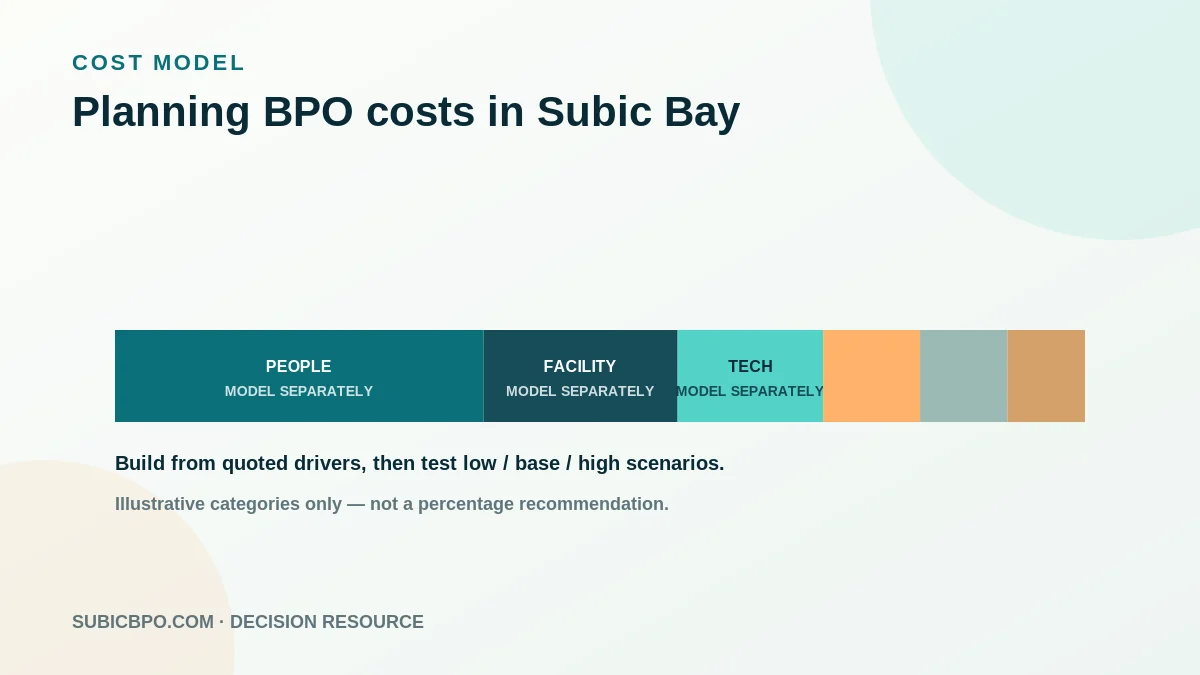
Build a Subic BPO budget from quotable cost drivers, not one generic “cost per seat” number.
A seat-cost figure becomes useful only after the staffing model, utilization, office design, technology, security, redundancy, management overhead and launch assumptions behind it are visible.
The best cost model is not the one with the most precise total. It is the one that shows which assumptions can still move the business case.
Start with workload and headcount, not seats
A seat is furniture and equipment. The business pays for people, management, space, systems and resilience.
Start with workload and service assumptions, then build a role-based staffing model.
Separate:
- production agents/specialists;
- team leaders;
- quality assurance;
- training;
- workforce management;
- HR/recruiting;
- finance/admin;
- IT/support;
- security/compliance;
- operations management;
- site leadership.
Then account for:
- leave;
- absence;
- training time;
- meetings/coaching;
- attrition and replacement lag;
- schedule coverage;
- peak-volume requirements;
- seat sharing across shifts.
A 100-seat office may support more than 100 employees across shifts, or fewer than 100 productive positions if utilization is low.
Use statutory wage data as a floor, not a BPO salary model
The National Wages and Productivity Commission currently lists the Region III non-agriculture minimum wage for Zambales at ₱600 per day after the second tranche of Wage Order RBIII-26 took effect on April 16, 2026.
That is a statutory reference point—not a competitive salary benchmark for BPO roles.
For every role, gather current market evidence from:
- active job advertisements;
- recruiter feedback;
- candidate interviews;
- salary surveys where reliable;
- existing operator experience;
- pilot recruiting results.
Model total employer cost rather than base pay alone. Depending on the employment structure, that can include statutory contributions, leave, holiday/night-shift treatment, benefits, recruitment, training, equipment and management overhead.
For a larger launch, use salary bands and separate entry-level, specialist and leadership assumptions.
Model occupancy in layers
Facility cost should be separated into recurring occupancy and setup/capital items.
Recurring occupancy
- rent;
- common-area or association charges where applicable;
- utilities;
- HVAC operating cost;
- generator fuel/maintenance allocation;
- cleaning;
- security;
- insurance;
- maintenance;
- parking/transport arrangements.
Setup and fit-out
- deposits and advance rent;
- architectural/engineering work;
- partitions and acoustics;
- electrical distribution;
- lighting;
- structured cabling;
- fire/life-safety modifications;
- access control/CCTV;
- furniture;
- server/network rooms;
- signage;
- generator/UPS work where required.
Amortize long-lived fit-out costs over a realistic occupancy horizon when comparing operating models.
Price connectivity as an architecture
Do not budget “internet” as one line item if uptime matters.
Model:
- primary circuit;
- backup carrier;
- diverse physical route where available;
- installation/non-recurring charges;
- edge/firewall equipment;
- SD-WAN/failover where used;
- public IP/address requirements;
- monitoring;
- voice/SIP/contact-center connectivity;
- temporary connectivity during setup.
Two provider contracts do not automatically create resilience if both enter the building through the same path.
Technology cost extends beyond desktops
Endpoints are only one part of the stack.
Depending on the service, model:
- laptops/desktops;
- monitors/headsets;
- endpoint-management tooling;
- operating-system/software licensing;
- identity/MFA;
- productivity suite;
- contact-center or CRM systems;
- ticketing/workflow software;
- network/security equipment;
- logging/monitoring;
- backup;
- password/privileged-access tools;
- device spares;
- warranty/support;
- cloud consumption;
- customer-specific licenses.
If software development, ecommerce operations or cybersecurity are part of the scope, the application and integration work can be more material than the endpoint purchase itself.
Price resilience explicitly
A low-cost design and a resilient design are not the same product.
Create a separate resilience block so management can see what availability actually costs:
- second carrier;
- path diversity;
- generator support;
- UPS runtime;
- endpoint spares;
- backup and restoration;
- security monitoring;
- alternate work arrangements;
- secondary workspace or remote contingency where permitted;
- incident-response capability.
Then compare those costs with customer requirements and the financial impact of downtime.
This avoids the common mistake of cutting continuity items from the base budget and later treating them as “unexpected” requirements.
Include launch costs and under-utilization
A new BPO is usually most expensive per productive employee during the launch phase.
Include:
- corporate/legal/accounting work;
- registration and permit work;
- project management;
- property design and fit-out oversight;
- recruitment marketing;
- recruiter capacity;
- pre-employment processing;
- training salaries;
- trainer costs;
- temporary connectivity;
- testing/commissioning;
- travel and accommodation;
- overlap with an existing operation/provider;
- customer onboarding;
- empty seats while recruiting ramps.
If the project requires 100 productive people in month six, do not model month one as though the entire cost base instantly reaches steady-state utilization.
Separate fixed, step and variable costs
This makes scale comparisons much more useful.
Fixed/semi-fixed: site leadership, core office, security, network edge, generator/UPS, base management.
Step costs: another team leader after a threshold, additional trainer, larger circuit, expanded space, added IT support.
Variable costs: production salaries, some licenses, headsets, certain benefits and telecom usage.
A 50-person operation and a 300-person operation may have very different average unit economics because fixed and step costs spread differently.
Build low, base and high cases
For any material assumption that is not yet contracted, use a range.
Example:
| Driver | Low | Base | High | Evidence status |
|---|---|---|---|---|
| Average loaded salary | Quote/test | Most likely | Stress case | Recruiting pilot |
| Monthly rent | Best viable site | Preferred site | Higher-spec site | Landlord proposal |
| Fit-out | Minimal | Required design | Contingency case | Contractor estimate |
| Connectivity | Basic | Resilient | Premium SLA | Carrier survey |
| Attrition | Stable | Expected | Stress case | Hiring/industry evidence |
The purpose is not to predict every peso. It is to identify the assumptions with enough sensitivity to change the decision.
Compare Build, Outsource and Acquire on total economics
Use the same service volume, quality requirements and forecast horizon for all three paths.
Build
Include setup, under-utilization and internal management time as well as steady-state operating cost.
Outsource
Include provider margin, minimum commitments, transition, vendor-governance effort and future exit/switching cost.
Acquire
Include purchase price, advisers, working capital, remediation, retention, customer/vendor consents and integration—not only the headline transaction value.
A company can rationally choose the option with the higher apparent monthly unit cost if it materially reduces launch risk or preserves flexibility.
Track quote age
Every external number in the model should have:
- source;
- date obtained;
- validity period;
- currency/tax treatment;
- owner;
- assumption or firm quote status.
Wage orders, exchange rates, rents, carrier pricing and software licensing all change.
A model that can be refreshed quickly is more valuable than a beautifully formatted workbook whose inputs have lost their provenance.
Primary sources and further reading
- NWPC Region III
Current Region III minimum wage matrix. - SBMA Cost of Doing Business
Official indicative Subic cost categories and telecom providers. - SBMA Business Registration
Public registration requirements that can create setup and professional-cost workstreams.